
Identify Who Owns a Lake County Property
Three official systems, used in order, answer the ownership question. XSoft turns an address into a property ID. The result also carries an "Owner Name" label. GIS confirms the APN and legal description point to the right land, while the Recorder's deed records show the newest recorded conveyance, the stronger documentary answer when someone asks who owns this property.
- Enter the situs address in Lake County Assessor XSoft and select the matching result.
- Copy the complete property ID and compare it with the GIS parcel and legal description.
- Use the Lake County Recorder index to locate the newest deed for that parcel or party.
- If the grantee is an entity or estate, follow the appropriate official business or probate record.
Two companion pages break this method into detail. For the present roll, see current property owner; for earlier conveyances, use past property owners.
Lake County XSoft Supplies the First Owner Label
The public Lake County Assessor data-only search accepts Owner, Address, or Property Number queries. Results list Property ID, Owner Name, Address and City. Map, Detail and Services actions sit alongside each row. That makes XSoft the practical first stop for anyone starting with an address; the Assessor's own search page displays the same result headings.
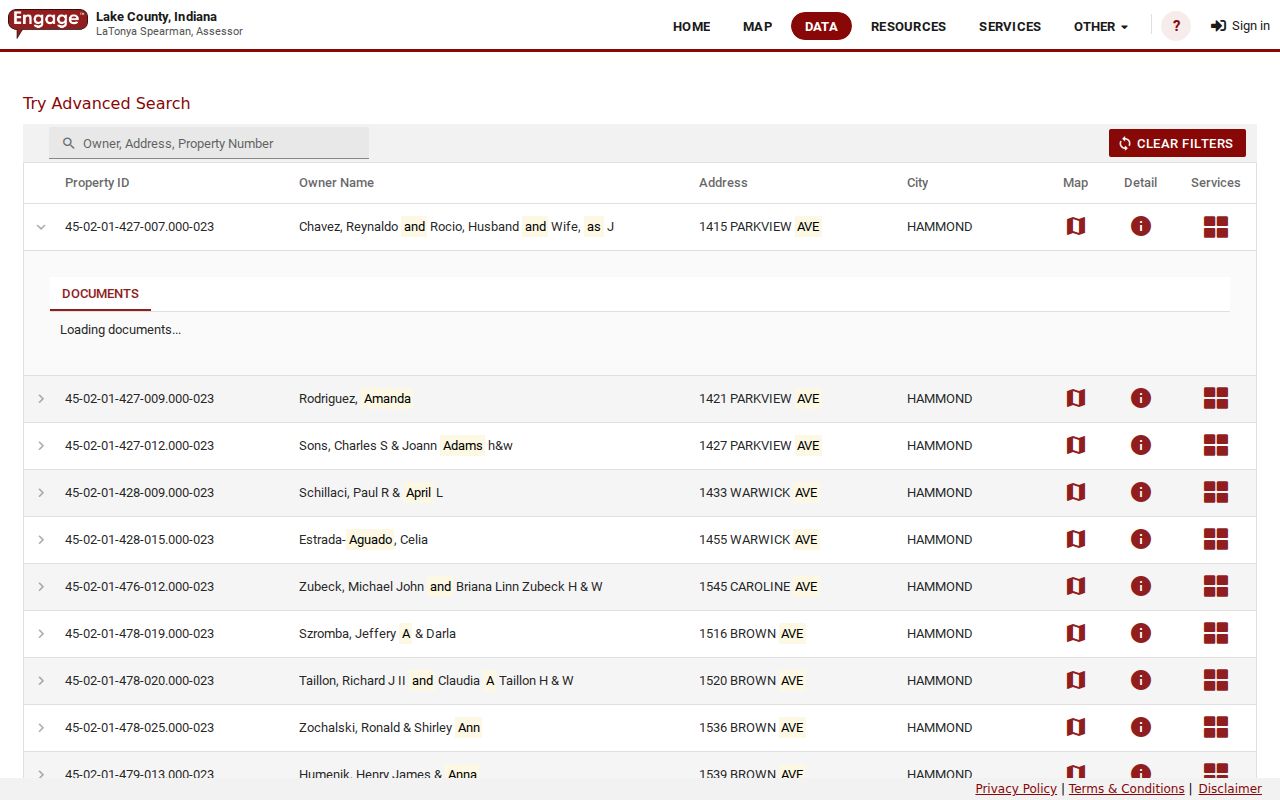
The page displays the exact "Owner Name" heading. It does not prove occupancy or rule out a later recorded instrument.
Separate the Lake County Situs from the Mailing Address
Situs means the physical land. The mailing address is simply where the county sends correspondence, and it can sit in another municipality or state. GIS stores both component and combined forms. An out-of-area mailing address therefore says nothing about whether the parcel search is wrong.
Anchor the parcel with the situs and APN. Treat the mailing address as an administrative contact field. A postal city may differ from municipal, township, sanitary or school-district geography. None of those labels alone proves possession or title.
- Owner of record
- The party currently named in the assessment roll.
- Situs
- The physical property location used to identify the parcel.
- Mailing address
- The delivery destination attached to the record.
- Grantee
- The party receiving an interest in a recorded conveyance.
Use Lake County GIS as a Parcel Cross-Check
Lake County's parcel service has an unusual field name. Its deed-related owner field is mdeededOwner. One sample feature exposes APN, situs and mailing components. It also exposes acreage, municipality, township, tax set, legal description, and direct Recorder, Assessor and Treasurer links. This is a GIS attribute with a particular source. It is not a declaration of "title owner."
Compare the XSoft owner label, the GIS legal description, and the newest Recorder instrument before trusting a mailing address. The embedded APN links cut transcription errors. They also keep all three checks tied to one parcel. For a working example, inspect an official Lake County parcel-service result.
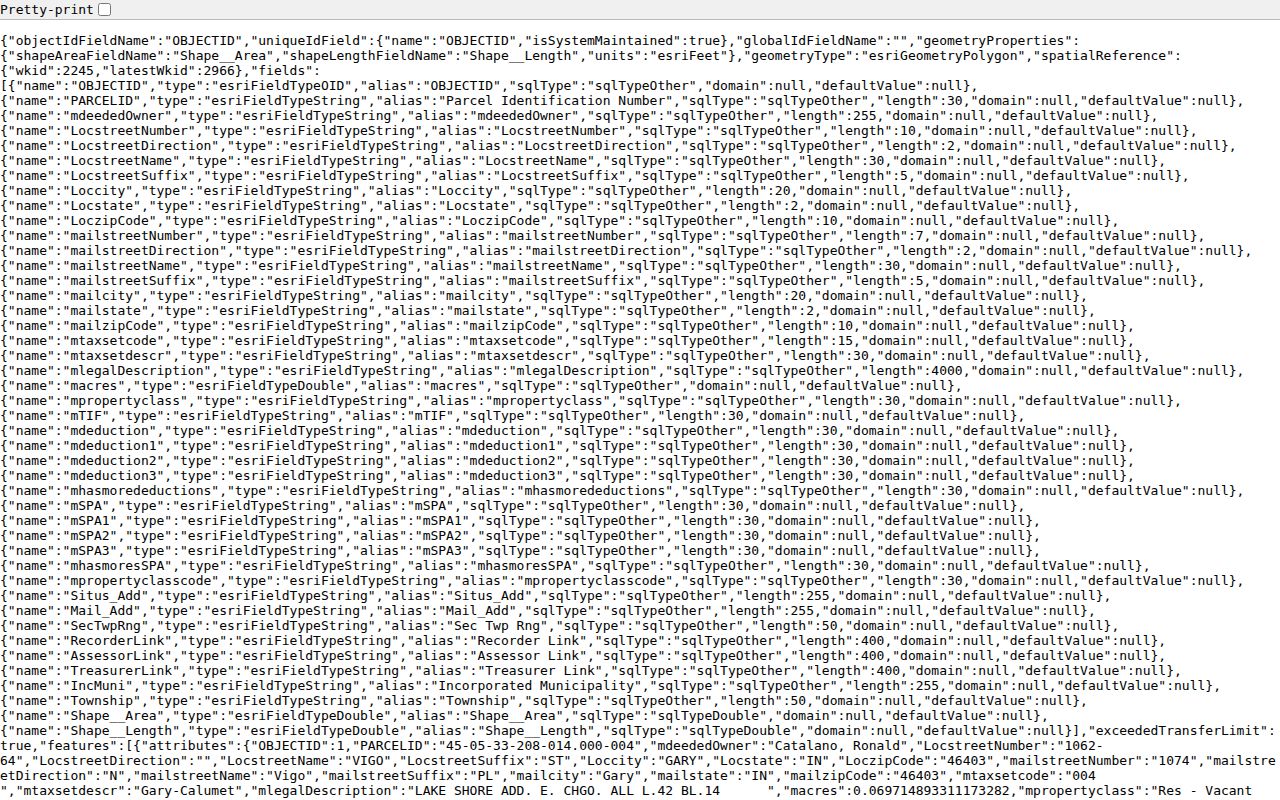
The sample shows many identifiers converging on one parcel. That makes it a model for cross-checking, never a substitute for the recorded deed.
Which Lake County Record Names the Property Owner?
Several Lake County records display a party name. Each serves a different operational purpose. Comparing their roles prevents the classic error of treating a tax or map label as final proof of title.
| Official source | Name or evidence shown | How to use it |
|---|---|---|
| Assessor XSoft | Owner Name, property ID and address | Fast owner-of-record starting point |
| GIS parcel service | mdeededOwner, APN and legal description | Confirm the correct mapped land |
| Recorder index | Parties and newest recorded conveyance | Check the instrument; account required online |
| Indiana INBiz | Entity, registered agent and governing-person fields | Research an LLC or corporation named as grantee |
The Treasurer keeps its own account name for taxation. XSoft owner, GIS deeded owner, Treasurer account name and recorded grantee may agree. Still, they are not interchangeable proof. A recent filing or a processing lag can make one system look newer than another.
Confirm Lake County Ownership with the Newest Deed
The Lake County Recorder portal is the confirmation step. Its landing page offers Register, Search and Advanced Search. Unauthenticated visitors hit a login wall. The oldest online year and exact grantor/grantee dropdowns stay behind that gate.
Match the parcel by legal description. Never rely on the name alone. The office describes more than three million documents spanning more than 200 years. Pages cost $1 each. A $3 administrative fee applies per order. For a closer reading of instrument types and copies, see the Lake County deed records guide.
Before searching deeds, view the Recorder's account gate.
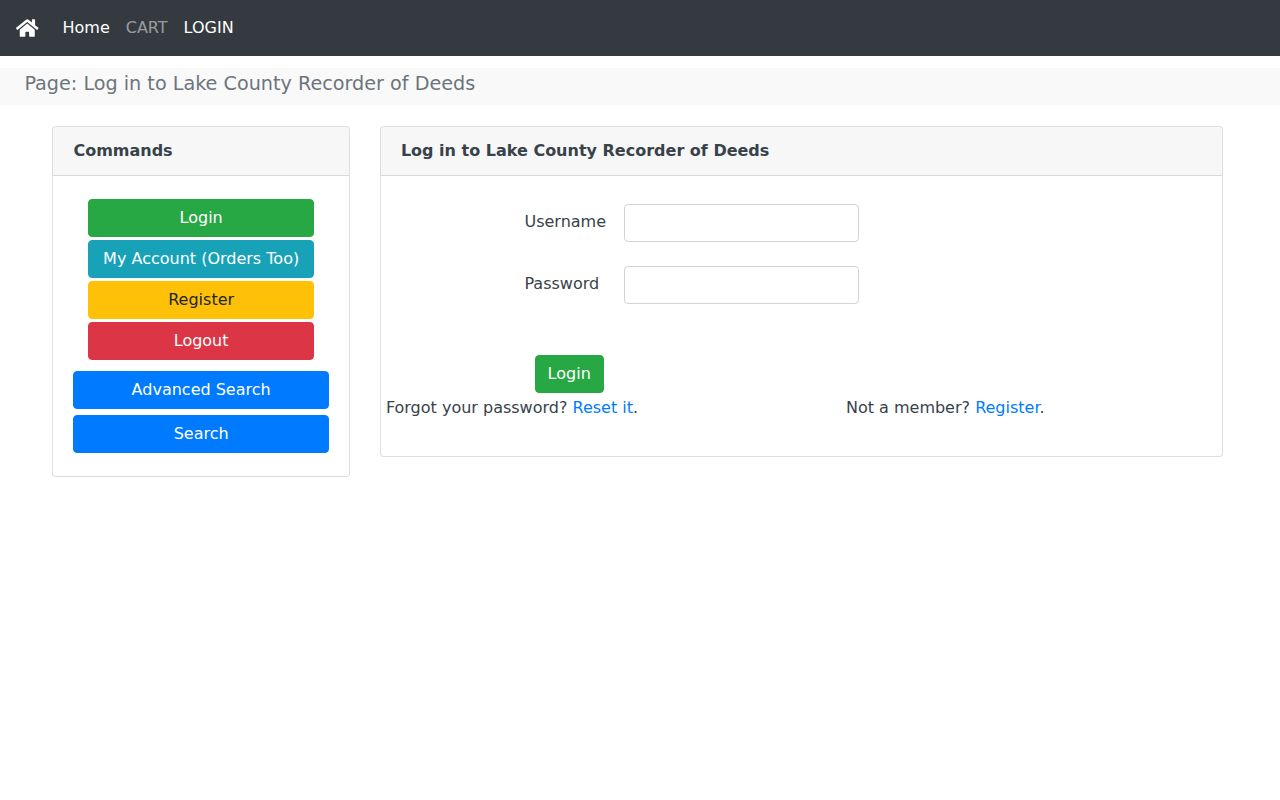
The login gate is itself an access fact. Register for web searching, or visit the Recorder's Crown Point office for help, older material and certified copies.
When a Lake County Owner Is an LLC, Trust or Estate
An entity name is not a dead end. When an LLC or corporation appears, search the official Indiana INBiz business database by entity, agent, person or address. Then return to the deed and legal description. A registered agent is a statutory contact, not necessarily the beneficial property owner.
Trusts and estates take different care. The public label may name a trustee, life estate, personal representative or estate. It rarely explains every underlying interest. Probate filings can clarify a transfer after death. Look to the Lake County Clerk or Indiana MyCase. Never infer heirs or ownership shares from the abbreviated assessor label.
Monitor a Lake County Owner Name for New Filings
The Lake County Recorder runs a free Property Fraud Alert. A subscriber submits names and gets notified by email or phone. Notifications go out when a matching document hits the property records. It is an early-warning tool, though. It does not stop a filing from being recorded. A match should lead you to inspect the actual instrument and call the Recorder about any deed that looks wrong.
Name variation matters here. Register the sensible forms that already appear on recorded deeds. Common names can trigger unrelated alerts. So treat each notice as a prompt rather than an answer. The service supports ongoing awareness after you identify an owner of record. It never settles the ownership question by itself.
Lake County Ownership Access When a Portal Falls Short
Online systems are not the only channel into Lake County property records. XSoft directs questions to the Assessor at 219-755-3100. The Recorder's Crown Point counter handles indexing questions, older deed books, and certified copies, while the Clerk and MyCase cover the court orders, judgments, wills, and probate matters that the Recorder says belong elsewhere.
A focused office request works best with the parcel number, legal description, likely party names, and an approximate transaction date. Indiana's Access to Public Records Act, Indiana Code 5-14-3, opens a formal request path for non-exempt agency records. Libraries and State Library land guides help with historic names. They corroborate research, but they cannot establish current ownership.
Scope matters too. Deeds, mortgages, liens, releases, leases, subdivision plats, UCC filings, assumed business names, and articles all live among the Recorder's recorded instrument families. Court judgments, orders, decrees, wills, marriage licenses, and vital certificates generally route to the Clerk, MyCase, the health department, or the Indiana Department of Health. Changing offices early prevents a false "no record" conclusion on your property search.
A recent death can explain an owner label that never changes. Probate records connect the public estate proceeding with a later deed. Search the court matter through Indiana MyCase or ask the Lake County Clerk, then return to the Recorder for the conveyance affecting the parcel. A will or probate order adds context, but the newest recorded instrument remains the real ownership confirmation.
For historical identity puzzles, Lake County Public Library offers directories, local histories, microfilm, and obituary searching by full or partial name, maiden name, date, city, and age. Those clues supply spelling variants or separate people with similar names. Pair them with the legal description and deed index. A directory entry alone never proves a household owned the parcel.
What a Lake County Property Owner Search Cannot Prove
An assessment or GIS map result cannot prove who lives at an address. Nor can it resolve every easement, lien, or unrecorded interest. It also cannot stand in for a title examination. Indiana's Address Confidentiality Program gives eligible safety-threatened participants a substitute address. Their real location then stays out of ordinary public-facing records. A missing residence address is not evidence of concealment or error.
Use ownership records lawfully. A Lake County owner lookup can support purchase research, boundary questions, estate work and civic transparency. Never use a name or address to stalk, threaten, harass or harm a person.
When a result will affect a purchase, estate, or boundary decision, get the actual recorded instrument and appropriate professional review. The method traces the public-record trail. It cannot turn a convenient database label into guaranteed title.