
Read Lake County's Current Owner Record
Start with the Lake County Assessor's XSoft data search. Its grid labels the field Owner Name plainly. It sits beside the property address, city, state, ZIP, and property number. Treat what you see as an assessment account. Those fields describe the parcel for tax purposes. They do not, on their own, establish legal title in Lake County.
| Owner Name | The name carried on the assessment roll. |
|---|---|
| Mailing address | Where assessment and tax correspondence is directed. |
| Property address | The situs, meaning the parcel's physical address. |
| Property number | The parcel identifier used to cross-check county systems. |
| GIS deeded owner | A separate map-layer label, not a substitute for the deed. |
| Recorded grantee | The party named as recipient in the latest conveyance. |
A Lake County owner record is not always tidy. The name shown may belong to a person, an estate, a trust, or a business entity. The mailing address can sit in a different city from the situs. Occupancy is a separate question altogether. Before treating a match as final, keep the parcel number and the legal description beside the name, since two owners in Lake County can share a name that looks nearly the same on screen.
The official Lake County XSoft data screen is the public entry point for this current-owner check.
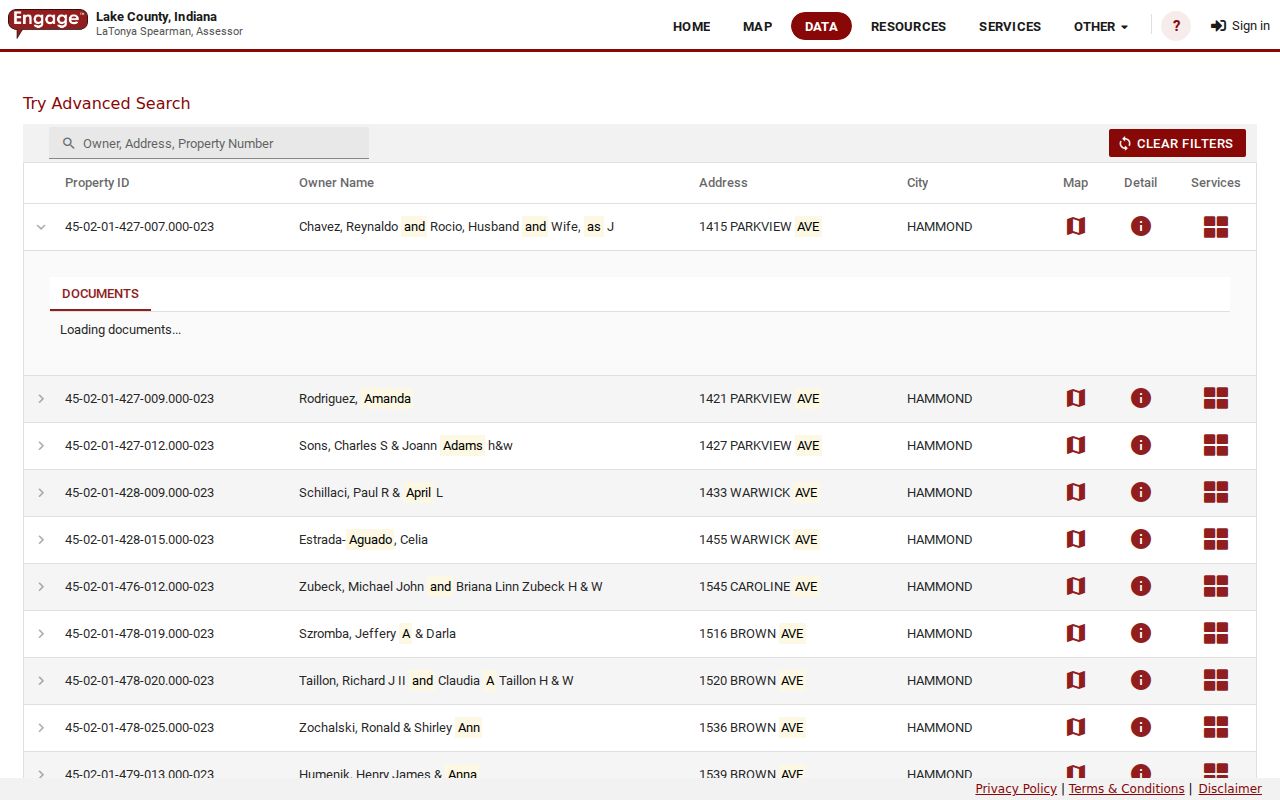
That same grid is the reason an Owner Name should always travel with its property number and address in a Lake County property search.
Check the Lake County Roll's Freshness
The XSoft screen the public sees lists its data as current through September 8, 2026. Treat that figure carefully. It marks the refresh of the public data screen. It is not a guarantee that every recent owner change landed in every field that day. Lake County also publishes no standard lag between a closing and the assessment roll. So a fresh sale can show up in a recorded deed. That can happen well before the assessment account reflects it. When timing matters, check the date on the property result against the recording date of the newest deed. Resist guessing at a fixed update interval. The Assessor, GIS, and Recorder systems each answer related questions. Yet each runs on its own workflow.
Note: A public-page freshness date does not guarantee that a deed recorded near that date has already changed the assessment roll.
Separate Situs and Mailing Addresses in Lake County
The situs address marks the land or improvement being assessed. The mailing address is where correspondence goes. It may point to a post-office box, a manager, or a representative in another city. Neither field proves who lives at the parcel. The gap matters all over Lake County. Postal labels, municipalities, and townships do not always describe the same geography there.
Lean on the property number as the stable bridge. It links an XSoft record to the GIS parcel and the Recorder route. This holds even when a street spelling or city label shifts. For lawful property correspondence, a public mailing address is a contact clue. It is never an invitation to repeated or unwanted contact.
Why Lake County Owner Labels Can Disagree
Each Lake County system labels ownership its own way. XSoft calls its field Owner Name. The GIS parcel service exposes a separate mdeededOwner field. The Treasurer may carry an account name, while a deed lists one or more grantees. These labels can sit close together without being interchangeable. A recent recorded transfer, a spelling choice, or a system refresh can explain the mismatch.
Key distinction. An assessment-roll name is useful current evidence, but the newest recorded instrument is the direct source for conveyance and vesting.
Lake County has its own version of a common ownership myth. The first name shown online is not automatic proof of formal title. Use the roll to locate the parcel, then test that name against the legal description and the latest conveyance.
Read Entity, Trust and Estate Owners
In Lake County property records, the owner of record is often not a person. An LLC, a corporation, a trust, or an estate may hold title instead. Copy the entity's wording exactly as it appears. A shortened name can hide the true parcel holder. For a business, the Indiana INBiz business search takes a business name, business ID, filing number, registered-agent name, or governing-person name. Its Contains, Starts With, and Exact Match modes help pin down the precise legal name.
Two cautions apply. A registered-agent address is not the parcel's situs address. It is not the company's main office either. Trusts and estates may not surface in a business search at all. The recorded deed or a probate file is the better route. For estate disputes and related matters, the Indiana MyCase portal offers public court-case clues. Those come within whatever access limits the court applies.
Match the Parcel Before the Person
Lake County property records work best when you match the parcel first. The county's full parcel number cuts down on false matches. The legal description helps too. So do the municipality and township fields. Owner names alone can trip you up. Two different people can share one, and spelling slips happen all the time.
- Confirm the street address or parcel number in XSoft.
- Open the same APN in the Lake County GIS viewer.
- Compare the legal description and municipality fields.
- Carry that APN into the Recorder search or office request.
The GIS sample goes a step further. It links straight to Recorder, Assessor, and Treasurer routes using the complete parcel number. That cross-link helps most when a street-name search turns noisy.
Verify Lake County's Current Property Owner
Finding the owner of record takes two steps. First, check the tax roll. Then compare what you find against the most recent deed held by the Lake County Recorder. The Recorder's portal requires an account to reach the actual search screen. Its public page does not state the oldest year in the online index. If online access stalls or a result seems unclear, the Recorder still helps people. It assists at the counter and through written contact.
- Read Owner Name and property number on Lake County Assessor XSoft.
- Search the Lake County Recorder portal for the newest deed tied to that parcel and name.
- Compare the grantee, recording date and legal description with the assessment record.
- Resolve a company through INBiz, or an estate through the relevant deed and court file.
- Owner of record
- The party identified in the public property record used for the inquiry.
- Assessment roll
- The Assessor's account and value record, which can lag a recent conveyance.
- Situs address
- The location of the assessed parcel, distinct from the mailing address.
- Recording lag
- The interval before a transfer appears across systems; Lake County publishes no standard duration.
Use the Recorder When Online Details Fall Short
The online portal can leave gaps. The Lake County Recorder is the office to call. The Recorder maintains deeds, mortgages, liens, releases, leases, and subdivision plats for Lake County. Visit the office at 2293 North Main Street, Building A, second floor, in Crown Point. Published hours run Monday through Friday, 8:30 a.m. to 4:30 p.m. Staff can work through index questions. They can also help with older book entries that the account-gated portal does not display.
The office reports a system covering more than three million documents. It also spans more than two hundred years of recordings. That figure is impressive. It does not pin down a precise online cutoff. Document images cost $1 per page, and each order carries a $3 administrative fee. Ask about certification if you need a formal copy.
Monitor Lake County Names for Unexpected Filings
The Recorder links a free Lake County Property Fraud Alert service. It watches for matching names and sends an early warning when a document gets recorded. It is a monitoring tool only. It does not block recording, and it does not prove a filing is fraudulent. When an alert arrives, compare its instrument details against the parcel. Also check them against the current owner of record. Then contact the Recorder about the actual document. Name matching can trigger benign alerts, so inspect the filing before drawing any conclusion.
Note: Register name variants used in deeds, but treat every alert as a prompt to inspect the instrument rather than a verdict.
Use Lake County Owner Records Lawfully
Owner records in Lake County can serve many legitimate purposes. An owner mailing address may help with a boundary question. It can also support an estate search or contact before a purchase. Indiana's Address Confidentiality Program substitutes a protected address for eligible people facing safety threats. Other confidentiality laws can limit disclosure too. Public availability never authorizes intimidation or repeated unwanted contact.
Lawful use. Indiana Code chapter 35-45-10 addresses stalking and harassment. Use Lake County current owner information only for lawful property and civic purposes.
A lookup is not a title examination. Finding an owner of record in Lake County is only a starting point. For a purchase, boundary dispute, estate, or other consequential decision, verify the record with the custodian and get professional help suited to the issue.