
Trace Lake County Former Property Owners
No single parcel card lists every former owner. Ownership history comes from transfers, one deed at a time. Begin with the newest Lake County deed and keep its legal description beside every name you collect. Then move backward conveyance by conveyance. The Recorder describes more than two hundred years of recordings. Its account-gated online index does not state the precise oldest year it reaches.
| Source | Years It Covers | Where Held | What It Shows |
|---|---|---|---|
| Recorder index | Exact online cutoff unpublished | Recorder portal or counter | Grantors, grantees and instruments |
| Older deed books | County recordings span 200-plus years | Recorder and archived media | Earlier conveyances by book and page |
| Early land sales | 1837-1857 | Indiana State Library guide | Early purchase context |
| Historic plats | 1869 and 1891 resources | State Library and county sources | Lot, block and subdivision geography |
Start online for the newest transfer. When the chain reaches past what a screen can show, the Recorder's books, microfilm and scanned material carry it deeper. Earliest private claims begin in federal land records.
Start Lake County Ownership History with the Newest Deed
Start with the current grantee. Read the grantor, deed type, recording date, instrument or book-and-page reference and legal description from that instrument, because each detail anchors the next step. Then hunt that grantor as a grantee in an earlier conveyance. Keep going while the parcel matches.
| Transfer point | Grantor to grantee | Deed clue | Parcel check |
|---|---|---|---|
| Newest deed | Prior owner to current owner | Latest recording date | Current APN and description |
| Earlier deed | Earlier owner to prior owner | Prior book/page or instrument | Same lot, block or metes-and-bounds land |
| Older book | Repeat backward | Manual index reference | Account for splits or combinations |
Not every instrument transfers land. A mortgage, release or lien can name an owner, so treat it as an encumbrance clue rather than another link in the former-owner sequence.
Use Recorder Channels for Lake County Former Owners
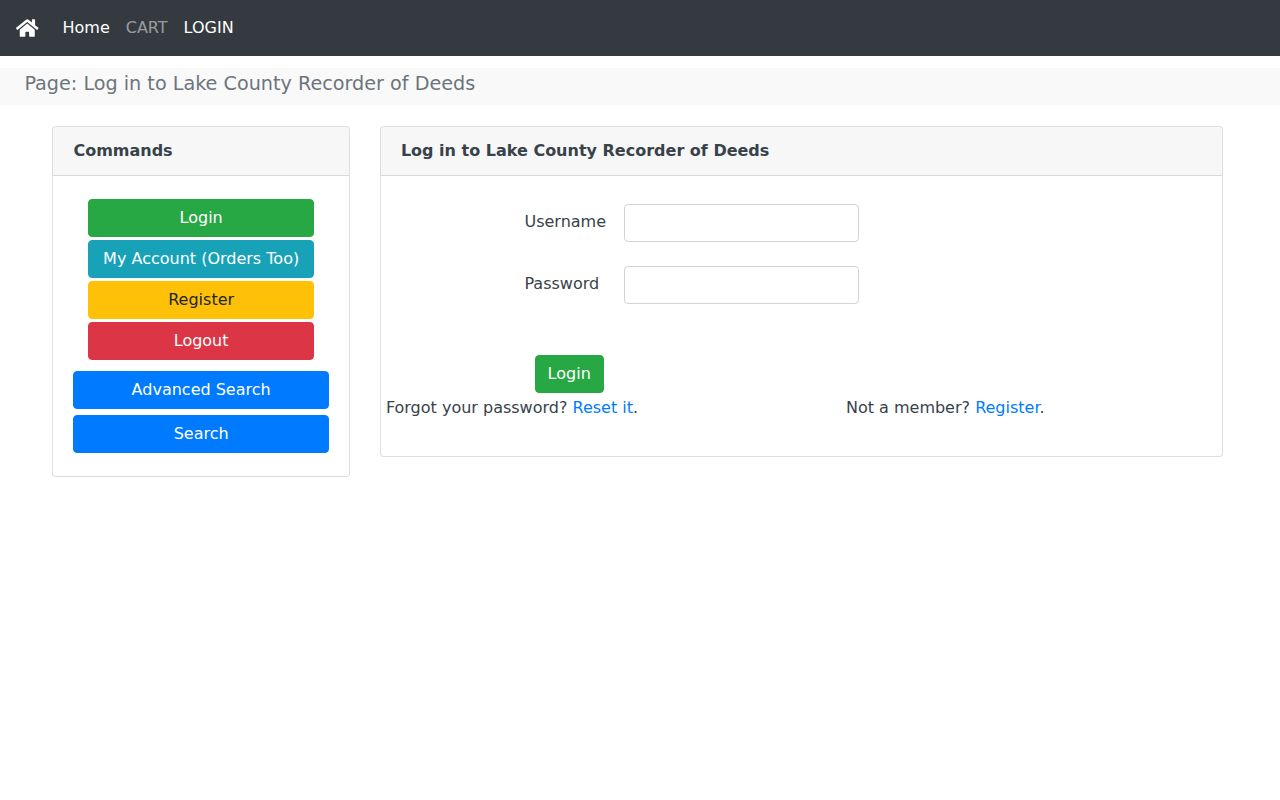
The Lake County Recorder portal pushes the actual instrument search behind a login for any visitor without an account. Registration is available, yet the landing pages leave the full field inventory and the oldest online year unstated. That gate does not make the deed private. The official Recorder login route is the access point.
Recorder's office staff handle the deeper historical work. That means older deed books, parcel number puzzles, and copy requests that stretch past what an account screen covers. The counter sits at 2293 North Main Street, Building A, second floor, Crown Point. Hours are weekdays from 8:30 a.m. to 4:30 p.m.
Prefer writing or calling? A mailed request works, and 219-755-3730 reaches the staff directly for index help.
Note: Ask which book, microfilm or scanned series continues the chain instead of assuming every old deed appears in the web index.
Match Former Lake County Owners by Legal Description
Streets change names; land does not. Lot-and-block or metes-and-bounds descriptions hold the identity. A parcel can also be split, combined or handed a new APN, so copy the complete legal description, subdivision or plat name, township and instrument date at every step. Those details separate same-named people. They also reveal when an old deed covered more or less ground than today's parcel. The county GIS parcel layer can crosswalk a modern APN to a legal description. Its boundary graphics are reference data, though. The plat and deed language control the trail. When an old address stops searching, work from the plat name and legal description instead.
Recognize Lake County Former Owners in Special Transfers
Sale-to-sale chains are rare. Probate deeds, personal-representative deeds, sheriff's deeds and tax-sale instruments can explain an abrupt change in the former-owner line. Search Indiana MyCase for a related public probate or foreclosure case. Then return to the Recorder for the instrument that moved the land. A court order or estate file may establish authority to convey, while the recorded deed supplies the parcel transfer. Treat them as complementary records. Sealed or confidential court material stays outside public access. Check any court name match against the property description.
Walk Lake County's Deed Chain Backward
A backward chain is a disciplined loop. It runs from the known current deed to the deed by which each prior grantor acquired the same property, step after step. Recording can lag execution, so keep both dates.
- Find the current owner's acquisition deed with that owner as grantee.
- Read the grantor and exact legal description from that conveyance.
- Search the grantor as an earlier grantee and compare the land description.
- Continue in deed books or archived media when the online trail ends.
- Grantor and grantee
- The conveying party and the receiving party named in a deed.
- Chain of title
- The ordered succession of instruments affecting ownership.
- Reverse index
- An index organized to find parties in the opposite grantor or grantee role.
- Quitclaim and warranty deed
- Different deed forms that may transfer an interest; neither label alone proves a perfect chain.
Extend Lake County Former Owner Research Through Archives
The Indiana State Library Lake County guide names early land sales and purchases from 1837 through 1857, plus an 1869 Plat Book for Appraisers and an 1891 plat resource. Those collections add settlement context. They cannot replace the Recorder's deed chain. Lake County dates to 1836. Finding an original private owner may take federal land records first, then the earliest county books. Recent preservation work matters too. December 2025 commissioner minutes list 2026 contracts for records storage, imaging and archive-to-microfilm conversion. No volume is promised online. A book-scanning initiative signals preservation, not universal access. Log every request. Note the volume, page, office response, and copy format. That audit trail lets a long former-owner search resume later without repeating shaky name matches. Indiana's Commission on Public Records says retention and destruction follow state schedules, and it sends researchers back to the originating department for copies. It is not a central deed archive. Ask the Recorder which surviving format holds an old volume's index and images. Use the library for context only. Never substitute a catalog description for the instrument itself.
Resolve Former Lake County Owner Name Variants
Name variants trip up most searches for past owners. The Lake County Public Library genealogy collection links deed names to obituaries, city directories, local histories, newspapers and microfilm. The obituary indexes cover the Post Tribune and Gary Post from 1921 to the present. They also cover the Lake County Register and Star from 1857 through 1938. You can search by name, partial name, maiden name, date, city or age. That helps when a deed record shows initials only.
Crown Point Library holds Haines criss-cross directories for Northwest Indiana from 1982 forward. It also holds scattered Robinson's Crown Point directories from 1941 through 1996. These volumes sort out initials, married names and old street addresses. Keep one caution in mind. Directories list households and occupants, not title. So confirm the identity in the deed records themselves before you accept a match.
How Far Back Lake County Former Owners Can Be Traced
Age is not a problem here. The Recorder advertises recordings over two hundred years old. Its collection tops three million documents. The catch is the web index, whose cutoff the office has never published. Older owner-of-record work may call for the counter. Deed books, microfilm, State Library resources and federal land records also help. FamilySearch catalog results make useful leads. Lake County lacks a complete unrestricted deed-book image collection.
Time-depth limit. Do not invent an online cutoff year. Ask the Recorder where the index stops and which older series continues the chain.
Tracing past owners serves real purposes. House history, estate work and purchase diligence all draw on historical names. Those names should never be used to harass a living person. A research chain is not a title opinion. So consequential ownership questions need verification with the custodian and suitable professional review.
Close the search by reading every transfer in date order. Check that the receiving party on one conveyance is the conveying party on the next. Flag any unexplained gap, parcel split or name change. A missing step means searching more records, not assuming the property passed.