
What Lake County Deed Records Document
Every deed names the parties and pins the transfer to a described piece of land. The Lake County Recorder also holds mortgages, liens, releases, leases, subdivision plats, UCC filings, and assumed business names. Check the document type before treating any index hit as proof that ownership changed hands.
| Deed Type | What It Does | Common Use |
|---|---|---|
| Warranty deed | Conveys the stated interest with deed covenants. | Ordinary purchase transfers |
| Quitclaim deed | Conveys whatever interest the grantor has without promising its extent. | Family or title-cleanup transfers |
| Trustee or executor deed | Conveys through a trust or estate representative. | Trust and probate administration |
| Sheriff's deed | Records a conveyance following a court-directed sale. | Foreclosure-related transfer |
| Tax deed | Records the instrument arising after the statutory tax-sale process. | Delinquent-tax property |
A mortgage or lien burdens land without conveying it. A release clears a claim. Read the parties, document type, recording date, and legal description as one package before adding anything to a deed chain.
Entering the Lake County Recorder Portal
The Recorder portal offers Register, Advanced Search, Search, and My Account routes. A public visitor requesting the instrument search without signing in lands on a login screen. The grantor-grantee fields, document-type choices, and oldest online year sit behind that account, so treat them as unknown until you register.
| Public control | Observed requirement | Purpose |
|---|---|---|
| Username | Required at login | Enter the account |
| Password | Required at login | Authenticate the account |
| Register | Username, password, email, first and last name required; phone optional | Create an account |
| Search / Advanced Search | Account-gated in the inspection | Reach recorded-instrument fields |
A login wall is an access condition, nothing more. Recorded instruments stay public records. If registration stalls or the portal misbehaves, call the Recorder or visit the courthouse counter.
The Recorder login route was captured during the portal review.
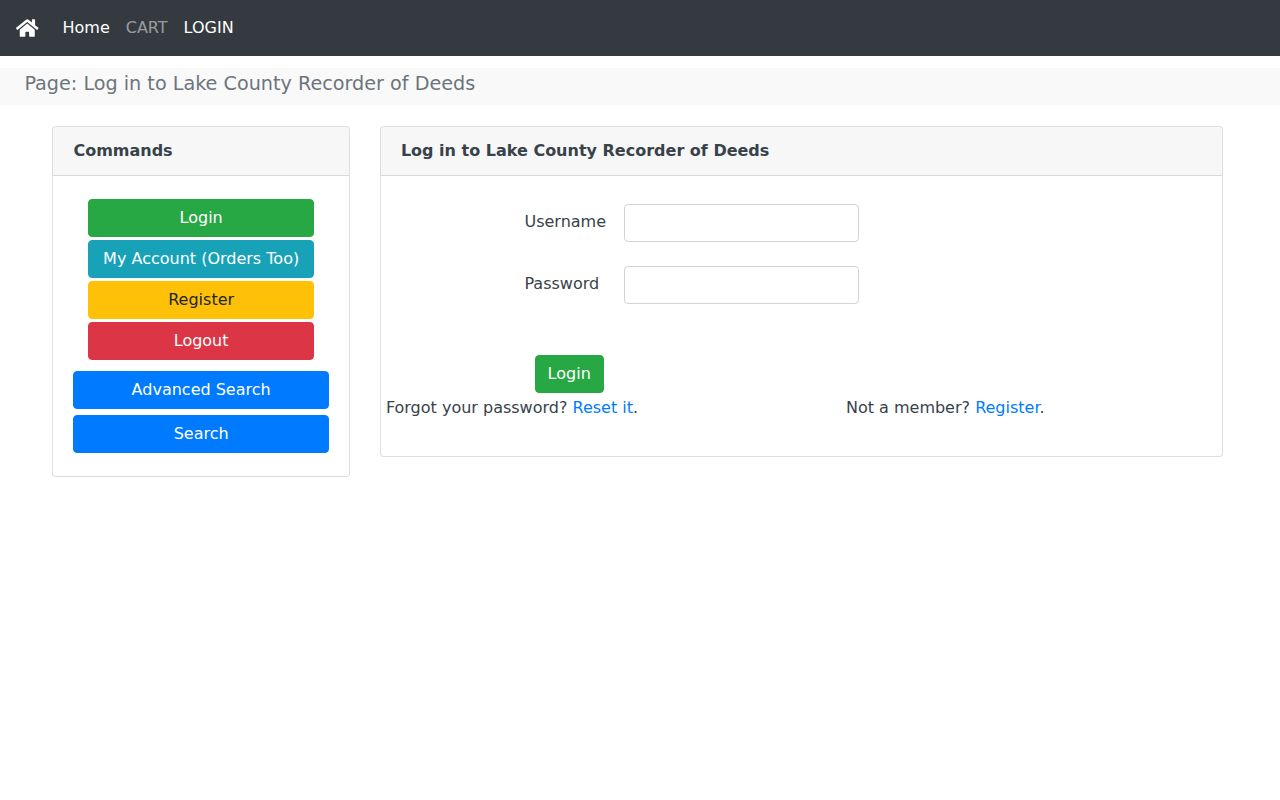
That screen explains itself. A public visitor may need an account, or the Recorder's in-person help, before instrument results appear.
More Than Three Million Lake County Instruments
The Recorder's information page describes more than three million recorded documents. They span more than two centuries of recordings. It names One Line Search and Individual Field Search. It does not publish an exact online cutoff for visitors outside the account.
The distinction matters. Collection depth is not the same as open web coverage. Older Lake County deed records may live in deed books, microfilm, or other preserved formats. Those formats may require staff help. Bring a party name, approximate date, legal description, and any book, page, or instrument reference already in hand.
Note: Read the two-century statement as collection depth, not a promise of complete online deed records.
The Recorder's record-search information page also documents the collection scale and image charges.
The page supports both points: deep holdings, gated access. It never claims every historic deed image is open online.
Walk Lake County's Grantor-Grantee Chain
Grantor and grantee roles let you walk a parcel's chain backward through recorded transfers. Start from the newest reliable owner clue. Keep the legal description beside every result, and never count an encumbrance as a conveyance.
- Use XSoft or GIS to obtain the parcel number, current owner spelling, and legal description.
- Find the current owner's acquisition instrument with that owner as grantee.
- Read the grantor from the deed and search that party as an earlier grantee.
- Repeat while checking dates, document types, and the same land description.
- When the web trail ends, ask the Recorder for the relevant book, microfilm, or archived index.
- Grantor
- The party conveying the stated interest.
- Grantee
- The party receiving the stated interest.
- Chain of title
- The connected sequence of instruments affecting the same land.
- Book/page or instrument number
- A recorded-document locator, not a street address.
The APN Keeps Lake County Deed Searches on Track
The public GIS parcel layer carries a RecorderLink built from the full parcel number. It sits alongside an AssessorLink and a TreasurerLink. When an address looks abbreviated or the mailing city differs, copying that APN beats retyping a street guess. It saves you from typing that guess into every system.
Use the link as a bridge, then confirm the legal description on the instrument itself. The GIS field is named mdeededOwner, and XSoft uses Owner Name. A deed names grantees. Those labels are not interchangeable proof of title.
Lake County's Early Land and Plat Trail
The Indiana State Library Lake County guide places early land sales and purchases between 1837 and 1857 and points to plat resources from 1869 and 1891. Lake County was created in 1836, so the earliest private-land trail may need federal land context before the county deed sequence settles into place.
A plat and a deed answer different questions. The plat organizes subdivision, lot, block, and mapped context. The deed records the conveyance itself. Pair them when a modern address no longer matches the name in an old index.
The Lake County Public Library genealogy collection adds directories, newspapers, obituary indexes, microfilm, and FamilySearch access. Those sources can resolve initials or a married name. The recorded deed remains the land-transfer evidence.
Scanning Does Not Mean Every Deed Is Online
The county publishes a Recorder book-scanning project. December 2025 commissioners minutes list 2026 records-storage and archive-image-to-microfilm work. That is active preservation. It is not proof that any named deed book is digitized or open on the web.
Ask the Recorder which format holds the date range you need. Ask whether the search happens at the counter, by staff request, in a physical index, or on microfilm. Indiana's Access to Public Records Act, Indiana Code 5-14-3, frames requests for non-exempt agency records. A focused request beats an open-ended demand for a title history every time.
Lake County Property Fraud Alerts Need a Deed Check
Deed fraud can strike any owner of record. The free Lake County Property Fraud Alert service watches recorded documents for a name you register, sending word by email or phone. It gives early warning, nothing more. The service cannot block a filing or judge whether a deed is valid. An unfamiliar alert deserves a closer look. Keep the alert details and contact the Recorder to inspect the instrument number, parties, date, and legal description. A name-only match may just be a similar name. A matching parcel and legal description, though, calls for prompt review.
Lake County Deed Access Beyond the Web
An online account is only one path. The Recorder's public counter is the direct route. Staff there handle confusing index entries, volumes missing online, image questions, and certified deed copies. Bring the exact owner spelling, the likely recording period, the parcel number, the document type, and the legal description. Those details let staff separate one parcel from another. They will not run an unlimited title search.
Written requests work too. Identify the instrument you want and state whether a plain reproduction or a certified copy is needed. Include any book and page or instrument number exactly as found. Ask the Recorder to confirm the fee and accepted payment method before sending funds. The posted online-image charge does not set the price of counter, mail, or certified service.
What if a non-exempt record is not posted? Indiana's Access to Public Records Act supplies the path. It has limits, though. APRA does not force an agency to create a title report, answer a legal question, or release material protected by another law. A narrow request for one identifiable document works best.
Historical deed research continues offline. Deed books, microfilm, the Indiana State Library Lake County guide, and the Lake County Public Library genealogy room all help. Library directories and obituary indexes can suggest name variants. The Recorder stays custodian of the land instruments. The county Commission on Public Records sets retention rules but sends copy requests back to the originating department.
Old addresses fail often. Search the subdivision, lot, block, or section-township-range description instead. Compare that description across successive instruments and note any parcel splits or combinations. A directory links a person to a street, but it proves nothing about ownership. A probate caption can name an estate representative, yet the deed still supplies the actual land transfer.
Note: Ask which format holds the needed year before traveling, because the published portal does not state its oldest searchable instrument date.
Order a Lake County Deed Copy
A deed copy from Lake County costs $1 per page plus a $3 administrative fee per order, according to the Recorder's published information. Confirm the current charge first. Decide plain image or certified copy. The web account handles routine requests. For certification, older volumes, index questions, or records missing from the portal, the Recorder counter is the fallback. Give the office party names, an approximate recording date, the parcel number, the legal description, the instrument type, and the copy type you want. Add any book and page number exactly. Retention rules are another matter. The county Commission on Public Records manages retention and destruction but sends researchers back to the originating department.
Recorded, not guaranteed. Lake County deed records show instruments accepted for recording. They do not establish that title is clear, complete, or free of unrecorded interests.