
Compare Lake County Property Value Types
Not every Lake County property value means the same thing. One card can show an assessed figure, a market value-in-use estimate, a taxable amount after deductions, and the consideration reported in a transfer. Each number comes from a different record. Each one answers a different question. So check value type, year and source first.
| Value | What It Is | Where |
|---|---|---|
| Assessed value | Mass-appraisal value used in Indiana's property-tax system | Lake County Assessor record |
| Market value-in-use | Indiana assessment concept tied to a property's current use | Assessment guidance and property record |
| Last sale price | Consideration connected with a particular transfer | Recorded instrument and sale fields |
| Taxable value | Assessment after applicable deductions | Assessment and tax account |
Indiana ratio studies compare each assessed value with its sale price. The assessment target is the state's market-value-in-use standard. A single sale, though, may reflect timing or condition. Deal terms can appear that mass appraisal cannot mirror. A deduction lowers the taxable amount without changing the parcel's underlying market evidence.
Find Lake County Value Fields in XSoft
The official route to a Lake County property card is the Lake County Assessor's XSoft portal. It serves as the entry point for assessment records. Owner name, property address and property number all work. Advanced search adds assessed-value minimum and maximum filters spanning $0 to $3,000,000. Sale-price, sale-date, year-built, living-area and acreage filters are also available. The Lake County XSoft landing screen is the assessment-record entry point.
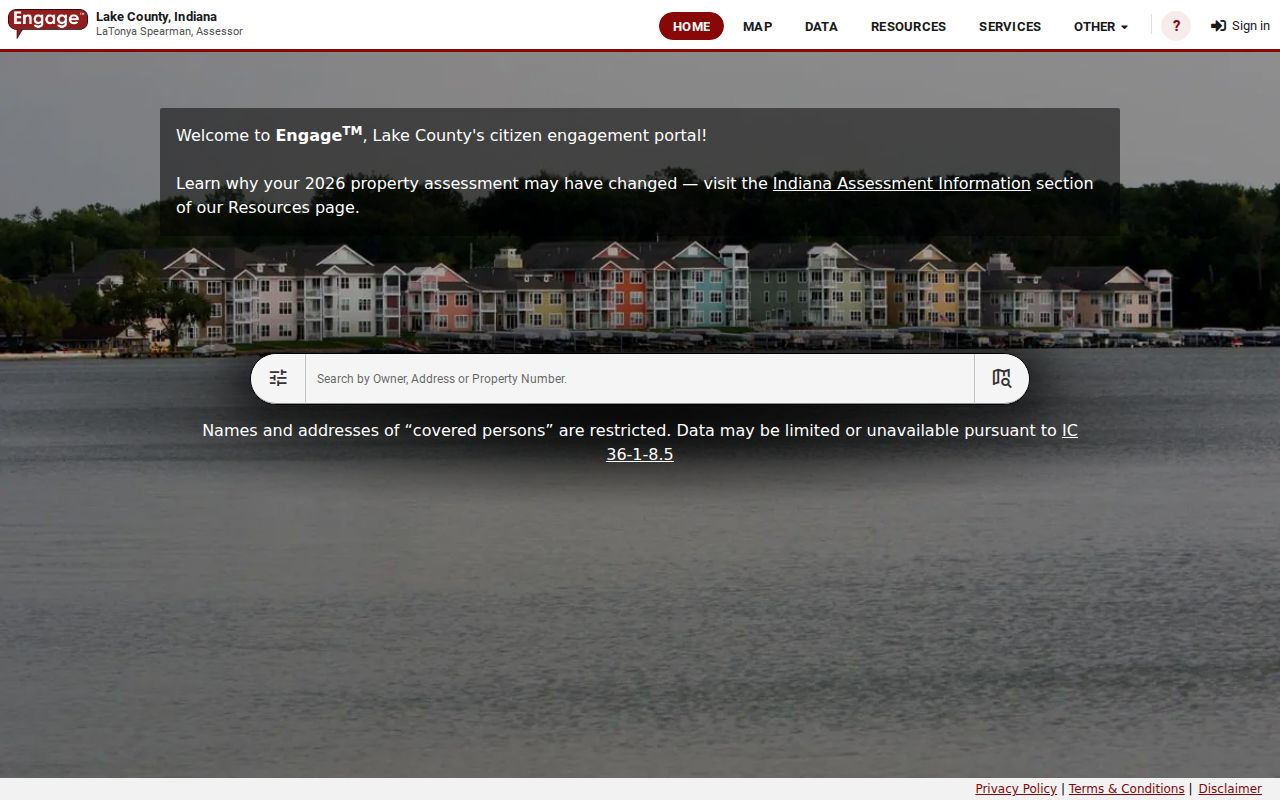
The portal capture places the value search in its official county assessment context.
| Search field | Format or choice | Value use |
|---|---|---|
| Assessed Value | Minimum and maximum | Find parcels in an assessment range |
| Sale Price | Minimum and maximum | Locate recorded sale candidates |
| Sale Date | MM/DD/YYYY range | Keep comparisons in a similar period |
| Neighborhood or District | Searchable select | Compare within local assessment geography |
The data screen shows its own currency date. That date reflects the portal's refresh schedule. It is not a guarantee that every field was updated the same day.
Separate Lake County Land and Improvement Clues
A Lake County property card may break the total assessed value into land and improvement components. That split shows what drove a change, whether site value, new construction or a building characteristic. No complete field dictionary exists for every detail card. Read the labels on your current parcel instead of assuming a hidden formula.
Year built, building style, property class, living area and acreage work well as comparison controls in XSoft. They do not create true appraisal comparables. Condition, location and the rights attached to the land can still differ between two parcels that look alike on paper. Caution pays off here.
Understand Indiana's Annual Value Adjustment
Indiana does not wait for a ten-year reassessment cycle. Annual trending adjusts values instead. So a Lake County assessed value can change with no sale. The Indiana Department of Local Government Finance publishes statewide assessment guidance and ratio-study context. It also provides property-tax forms. Keep the assessment year beside every figure you record. Comparing a current assessment against another parcel's older number can create a false gap. Assessment disputes follow a separate path. The formal conference and Form 130 process belong to the tax-record and appeal workflow, not to a market-value estimate.
Note: An annual assessment change may reflect trending or corrected property data even when no arm's-length sale occurred.
Test a Lake County Sale Price Against the Deed
XSoft's advanced form filters by sale price and sale date. A sale row is only a lead, though. For consequential research, inspect the instrument through the Lake County Recorder portal or contact the office, then confirm the parties, recording date, deed type, legal description and any stated consideration.
A family transfer, quitclaim, sheriff's deed or estate transaction may not behave like an open-market sale. Not every recorded conveyance is a market comparable. The Recorder search is account-gated. The office counter or written contact is the documented fallback.
Look Up a Lake County Value
Start with the exact parcel number. Then read each value in its year and assessment context, so a similarly named road or owner cannot steer you to the wrong property card.
- Search the address or property number in Lake County XSoft.
- Confirm the APN, situs and legal description before reading value fields.
- Record assessed value, land or improvement components, deductions and year as displayed.
- Check the recorded instrument before treating a sale amount as market evidence.
- Assessed value
- The mass-appraisal figure used in the property-tax system.
- Market value-in-use
- Indiana's value concept based on the property's current use.
- Assessment ratio
- Assessed value divided by sale price in ratio-study analysis.
- Sale consideration
- The amount or value connected to a specific recorded transfer when shown.
See How Deductions Change Lake County Taxable Value
Homestead, residential and other deductions reduce taxable assessed value without rewriting the market evidence underneath. A deduction is not a sale and not a valuation. A homestead flag is a clue for the assessor and the tax roll. It is not proof that a named person occupies the parcel. So check its status in the correct year.
The Treasurer account answers a different question. It shows tax due, paid or delinquent. A balance is not a property value. For bills, exemptions and appeals, use the Lake County property tax records guide. Do not derive tax conclusions from this comparison.
Compare Similar Lake County Parcels Carefully
XSoft offers searchable choices for building style, property class, neighborhood, district, stories and housing plan, including Auburn Hills, Brookwood, Devonshire Woods, Innsbrook, Prairie Creek, Sedona and many other Lake County neighborhoods. The filters can narrow a set of parcels with broadly similar recorded traits. Use them as a first pass.
District labels can mix several geographies. Municipality, township, sanitary and school boundaries may all appear in one label. A mailing city and ZIP can also differ from the actual jurisdiction. Retain the parcel number, neighborhood and assessment year. Never assume one city label means the same value context.
Read Detailed Lake County Numbers in Context
A public GIS entry for a Gary parcel can show acreage to nine decimal places. That is not a typo. The same record lists a two-percent deduction, tax set 004, and a lot-and-block legal description. County data gets that granular.
Granularity has limits, though. Not every digit on the screen helps with a market estimate or a boundary call. Give each source its own job. Use the GIS legal description and APN to confirm the parcel, XSoft for the assessment record, the Recorder for the transfer, and an appraisal for a supported view of likely sale value.
Unusually precise figures deserve the same skepticism. Recorded acreage may run many decimal places while a real boundary dispute still turns on survey evidence. A deduction percentage lives in the tax record, while a sale figure belongs to its own transaction.
Keep purpose and limits in view. When several Lake County records sit side by side, build a small dated table listing APN, assessment year, assessed value, deduction status, sale date, and source. Check parcels and transfer types first. A mismatched year or a non-market deed distorts a comparison more than a visually obvious property difference, so hold off on any implied market conclusion until those basics line up.
Know What Lake County Assessed Value Cannot Prove
An assessed value exists to support tax administration. It is not a promise of what a buyer will pay, a substitute for inspecting condition, or a conclusion about title and boundaries. Public cards can contain errors too. A card may also carry data from an effective date that differs from a recent sale.
Value versus price. A Lake County assessed value is not a sale appraisal. Obtain a qualified appraisal when a supported market opinion is needed.
Confirm the current card with the Assessor if a factual item looks wrong. Keep tax-bill questions with the Treasurer. Recorded-sale questions belong to the Recorder. That way one number is never asked to answer every property question at once.
For purchase or sale planning, blend the official record with current physical condition. Bring in qualified valuation work as well. Public Lake County values make a strong documentary starting point. They identify the parcel and its assessment basis, but they remain one input rather than a promise of price. Note: Save the access date with every figure.